
- A UAE employment visa and a labor card (work permit) are two distinct legal documents issued by two different authorities, and both are mandatory before an employee can legally work.
- Your company's visa and labor quota is tied directly to your license type, office space (Ejari), and jurisdiction — not simply to how many visas you 'want.'
- Mainland companies route labor cards through MOHRE, while most Free Zone companies issue work permits internally through their own authority's e-services portal.
- Wage Protection System (WPS) compliance is now a core condition of maintaining valid labor cards for Mainland and many Free Zone establishments, and non-compliance can freeze your ability to process new visas.
What Actually Makes Up a UAE Employment Visa and Labor Card
Foreign entrepreneurs often use the terms 'employment visa' and 'labor card' interchangeably, but UAE immigration and labor law treat them as separate instruments issued by separate authorities, each with its own validity, renewal cycle, and compliance obligations. Understanding this distinction is the first step to building a compliant hiring process for your company.
The employment visa (also referred to as a residence visa) is issued under the authority of the General Directorate of Residency and Foreign Affairs (GDRFA) in Dubai, or the Federal Authority for Identity, Citizenship, Customs and Port Security (ICP) in other emirates. It grants the foreign national legal residency status in the UAE and is the document that gets stamped into the employee's passport. Without it, an individual cannot legally reside in the country as a resident, regardless of whether they hold a valid employment contract.
The labor card, formally known as a work permit under the Ministry of Human Resources and Emiratisation (MOHRE), is a separate authorization that confirms the individual is permitted to be employed by a specific company, in a specific job title, under specific contractual terms. For Mainland companies, this card is issued through MOHRE's e-services platform. For Free Zone companies, the equivalent document — often called a work permit or employee card — is typically issued directly by the Free Zone authority itself, which acts as the labour regulator inside its own jurisdiction.
This dual-authority structure means a Mainland company in Dubai (/dubai-mainland) will coordinate with both GDRFA and MOHRE for every single hire, while a Free Zone company such as one registered under Meydan (/meydan-freezone), IFZA (/ifza-freezone), or Shams (/shams-freezone) will primarily deal with its own Free Zone's internal portal for the labor side, with GDRFA still handling the residency visa stamping.
Many first-time employers assume their trade license alone authorizes them to hire. In reality, you need an active establishment/labor file with MOHRE or your Free Zone, a confirmed visa quota, and a signed employment contract uploaded to the relevant system before any work permit can be issued.
The Step-by-Step Journey: From Offer Letter to Final Labor Card Issuance
The employment visa and labor card process follows a largely standardized sequence across Mainland and Free Zone jurisdictions, though the specific portals and intermediate approvals differ. Employers who understand this sequence in advance avoid the most common delay: starting an employee's visa process before the company's own establishment file and quota are properly set up.
Before any individual hire can begin, the company itself must have an active labor/establishment card (sometimes called a company immigration file or MOHRE establishment card) linked to its trade license, along with a confirmed quota of visas it is permitted to sponsor. This company-level registration is a prerequisite, not an optional add-on, and is typically arranged at the same time as the trade license or shortly after.
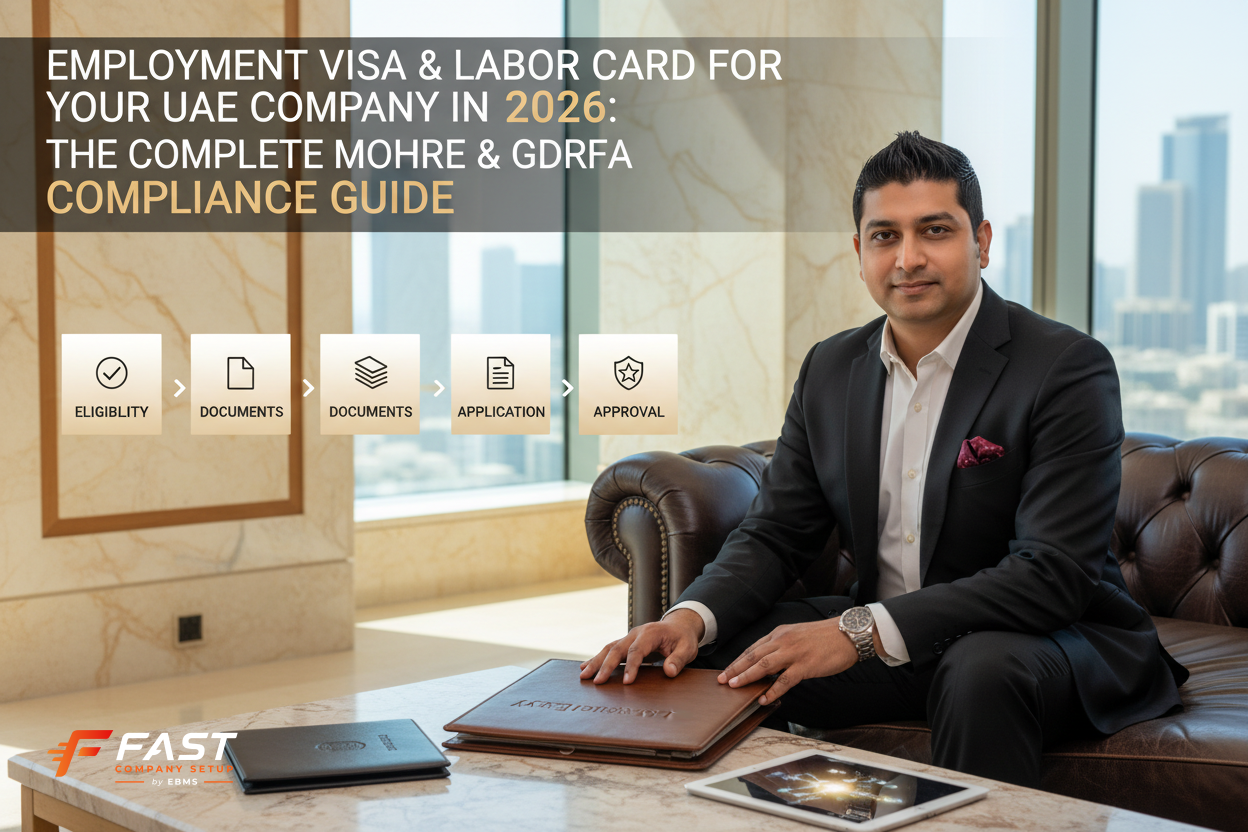
Once the company-level file is active, each individual hire generally proceeds through the following stages, though exact terminology and portal names vary by emirate and Free Zone.
A full cycle from signed offer letter to final labor card and Emirates ID in hand typically runs several weeks, depending on medical test scheduling, document readiness, and whether the candidate is inside or outside the UAE. Confirm current processing windows with MOHRE, GDRFA, or your Free Zone authority, as digital portal speeds are periodically updated.
Visa Quotas and Establishment Capacity: Why Your License Structure Decides How Many People You Can Hire
One of the most misunderstood aspects of UAE employment visas is the concept of a visa quota — the maximum number of employment visas your company is initially permitted to sponsor. This quota is not arbitrary; it is calculated based on your license type, your registered office space, and in Mainland cases, sometimes your activity classification.
For Mainland companies (/dubai-mainland), the Dubai Department of Economy and Tourism (DET) and MOHRE jointly determine your initial quota largely based on the square footage of your leased office under a valid Ejari (tenancy contract registration). A small flexi-desk or shared office typically supports a modest initial quota, while a larger standalone office or warehouse facility supports a significantly higher allocation. Businesses that outgrow their initial quota can apply for a quota increase, usually by upgrading their office space or demonstrating business activity levels that justify additional headcount.
Free Zone companies calculate quotas differently. Jurisdictions such as Meydan (/meydan-freezone), IFZA (/ifza-freezone), and Shams (/shams-freezone) typically bundle a fixed number of visa allocations into specific license packages — for example, a package might include zero, one, two, or more visa slots depending on the facility type chosen (virtual desk, flexi-desk, or dedicated office). Businesses needing a larger workforce generally need to select a higher-tier facility package or request additional visa allocation directly through the Free Zone's e-services portal.
This is why visa planning should happen before you choose your jurisdiction and office package, not after. A founder expecting to hire ten employees within the first year needs a license and office structure that supports that quota from day one, rather than discovering mid-year that their package only supports two visas.
Our relationship managers map your projected headcount against jurisdiction quota rules before you commit to a license package, so you avoid mid-year office upgrades purely to unlock additional visa slots.
Costs, Timelines & the Role of WPS Compliance in Keeping Your Labor File Active
Employment visa and labor card costs in the UAE are composed of several line items: entry permit fees, status change or stamping fees, medical test fees, Emirates ID fees, and the MOHRE or Free Zone work permit fee itself. These costs are set and periodically revised by the relevant federal and local authorities, so founders should always confirm the current government fee schedule at the time of processing rather than relying on figures from a prior year.
Beyond the one-time issuance costs, companies must also budget for mandatory employee health insurance (a legal requirement in Dubai and most emirates before visa stamping can be completed), as well as renewal cycles — most employment visas and labor cards are valid for a set multi-year term and require renewal with repeat medical testing and fee payment.
A critical and often underestimated compliance layer is the Wage Protection System (WPS). WPS requires employers to pay employee salaries through an approved banking or exchange house channel within a specified window each month, electronically reporting the payment to MOHRE. Non-compliance — late salary transfers, incorrect salary amounts relative to the labor contract, or simply failing to register for WPS — can result in the suspension of your company's ability to process new work permits, apply quota blocks, and trigger escalating fines. This makes WPS compliance a direct gatekeeper to your ongoing ability to hire.
Because payroll, visa costs, and corporate financial obligations are closely intertwined, many companies integrate their HR and payroll compliance with their broader accounting function. Proper bookkeeping (/accounting-services-in-dubai) ensures that salary disbursements, end-of-service gratuity accruals, and visa-related costs are accurately tracked and reconciled against your company's financial statements — which also feeds directly into your UAE Corporate Tax (/corporate-tax-filing-dubai) filing obligations, since employee costs are a deductible business expense that must be properly documented.
Government visa, medical, Emirates ID, and work permit fees are set by federal and local authorities and are subject to periodic revision. Always confirm the live fee schedule with MOHRE, GDRFA, ICP, or your Free Zone authority before budgeting, or request a current fixed-fee breakdown from Fast Company Setup LLC FZ.
| Jurisdiction Type | Typical Visa Processing Approach | Initial Visa Quota Basis | Key Compliance Authority |
|---|---|---|---|
| Dubai Mainland (DET) | Entry permit via GDRFA, work permit via MOHRE | Office size (Ejari) & activity type | MOHRE + GDRFA |
| Meydan Free Zone | Internal e-services portal + GDRFA stamping | Bundled into license/facility package | Meydan FZ Authority + GDRFA |
| IFZA Dubai | Internal e-services portal + GDRFA stamping | Bundled into license/facility package | IFZA Authority + GDRFA |
| Shams (Sharjah Media City) | Internal e-services portal + ICP stamping | Bundled into license/facility package | Shams Authority + ICP |
| RAKEZ (Ras Al Khaimah) | Internal e-services portal + ICP stamping | Facility tier (flexi-desk vs warehouse) | RAKEZ Authority + ICP |
Common Compliance Pitfalls and Strategic Hiring Considerations for 2026
Even well-intentioned employers run into avoidable complications when managing employment visas and labor cards. One frequent issue is allowing an employee to begin working before their labor card is fully issued — relying only on the entry permit or a partially processed visa. Under UAE labor law, employment is only authorized once the work permit itself is active, and allowing someone to work before this stage exposes the company to fines and potential labor dispute liability.
Another recurring pitfall involves visa cancellation timing when an employee resigns or is terminated. Employers are required to formally cancel the visa and labor card within a prescribed window and settle the employee's end-of-service entitlements (gratuity, outstanding salary, repatriation obligations where applicable) in accordance with UAE labor law. Delaying cancellation can leave the employer administratively liable for an individual who is no longer actually employed, and can also block that employee's ability to take up new employment elsewhere.
Absconding reports are another area requiring careful handling. If an employee stops reporting to work without formal resignation, employers must follow the correct MOHRE/GDRFA reporting procedure rather than simply ignoring the situation, as unresolved cases can affect the company's labor file standing and future quota approvals.
On the strategic side, founders should also consider how their hiring plans intersect with the UAE Golden Visa framework. Senior executives earning a qualifying monthly salary with the right academic credentials may be eligible for the Specialized Talents & Executives Golden Visa track, offering 10-year renewable residency without employer sponsorship — a valuable retention tool for key hires. Business owners themselves may separately qualify for the Business Investor Golden Visa route based on company shareholding value, which is a distinct pathway from standard employee visa processing.
Finally, companies restructuring between Mainland and Free Zone, or expanding into a second jurisdiction, must remember that labor files and visa quotas do not automatically transfer. Each jurisdiction maintains its own establishment card and quota system, meaning a company holding both a Mainland license and a Free Zone license will manage two entirely separate employment visa pipelines, each with its own compliance obligations and MOHRE or Free Zone reporting requirements.
Fast Company Setup LLC FZ's PRO services desk manages the full employment visa and labor card lifecycle — from entry permit to final work permit issuance and renewal — so your HR team can focus on hiring decisions rather than paperwork sequencing.
Frequently Asked Questions
Questions About This Topic

Abdul Salam
Licensed UAE Corporate AdvisorVisas & Banking DeskCEO
Direct specialist processing UAE 10-Year Investor Golden Visas and expediting corporate bank accounts with Emirates NBD, Wio, and Mashreq.