

- Management consultancy in Dubai is licensed as a 'professional activity' rather than a commercial one, which changes ownership, office, and compliance rules.
- Mainland consultancy licenses allow unrestricted access to private and government clients UAE-wide, while free zone licenses suit consultants serving international or free zone clients.
- All consultancy entities — mainland, free zone, or offshore — must register for UAE Corporate Tax with the FTA, even if annual profit stays below the AED 375,000 threshold.
- Qualifying Free Zone Persons providing consultancy services to clients outside their free zone or outside the UAE may still access the 0% corporate tax rate on qualifying income, subject to substance and activity rules.
How Dubai Classifies a Management Consultancy License
A management consultancy license in Dubai falls under the category of 'professional services,' which is treated differently from commercial trading licenses under both the Dubai Department of Economy and Tourism (DET) and the UAE's various free zone authorities. Instead of buying and selling goods, a professional license permits an individual or company to sell expertise — strategy advisory, operational restructuring, HR consulting, feasibility studies, market entry planning, and similar knowledge-based services.
This distinction matters because professional licenses are typically evaluated on the qualifications and experience of the practitioner or the firm's directors, rather than on share capital size. Activity descriptions used by DET and most free zones include variations such as 'Management Consultancy,' 'Business and Management Consultancy Services,' and 'Management Studies and Development Consultancy' — each carrying slightly different scope definitions, so selecting the precise activity code at the application stage avoids later restrictions on the services you can legally invoice for.
Foreign investors should also be aware that some consultancy sub-categories trigger additional scrutiny or external approvals. Generic management or strategy consultancy usually does not require outside regulator sign-off, but adjacent activities — such as engineering consultancy, legal consultancy, financial/investment advisory, or medical management consultancy — may require clearance from bodies like the Dubai Health Authority, Securities and Commodities Authority, or relevant professional bodies. Confirming the exact activity description against your intended service lines before filing is one of the most common points where generalist formation agents cause delays.
Amending an activity description after licensing often means re-submitting documents, paying new approval fees, and in some cases reissuing your license. Fast Company Setup's advisory desk maps your actual service offering against the correct DET or free zone activity code before submission, so your license matches exactly what you intend to invoice clients for.
Infographic: Management Consultancy License Dubai 2026: The Complete Activity, Jurisdiction & Compliance Guide for Foreign Consultants

Process roadmap and essential regulatory steps for Management Consultancy License Dubai 2026: The Complete Activity, Jurisdiction & Compliance Guide for Foreign Consultants.
Mainland vs Free Zone for Your Consultancy Practice
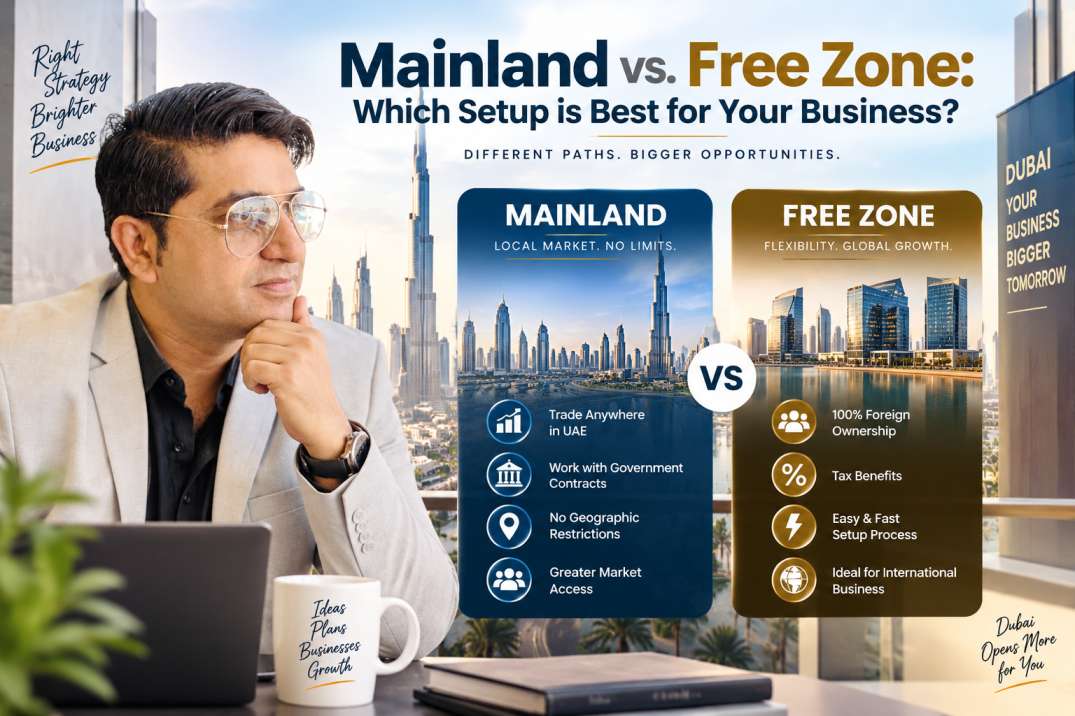
The jurisdiction choice for a management consultancy license comes down to who your clients are and where you need to legally operate. A Dubai Mainland license, issued by DET, allows you to contract directly with any UAE-based client — private sector, individuals, or government entities — without restriction, and permits renting office space anywhere in Dubai. This is the preferred route for consultants targeting local corporates, government advisory mandates, or UAE-based SMEs as primary clients.
A free zone license, by contrast, is ideal if your consultancy work is largely international, cross-border, or aimed at clients within the same free zone ecosystem. Free zones such as Meydan Free Zone, IFZA Dubai, and Shams (Sharjah Media City) offer cost-efficient, fast digital onboarding specifically suited to independent consultants, boutique advisory firms, and remote-first consultancy teams who do not need unrestricted mainland market access.
SPC Free Zone in Sharjah also offers a dual-license structure, letting a consultancy firm hold both a free zone and mainland presence under coordinated registration — useful for consultants who expect to grow from purely international clientele into direct UAE mainland engagements without restructuring the entire company later.
Free zone flexi-desk packages are generally sufficient for consultancy visa quotas tied to one or two visas. If your growth plan includes hiring a consultancy team of five or more, a mainland setup with a dedicated physical office under /dubai-mainland may offer more predictable scaling for staff visas and client meetings.
| Jurisdiction | Best Suited For | Office Requirement | Market Access |
|---|---|---|---|
| Dubai Mainland (DET) | Government & corporate advisory clients | Physical office / Ejari required | Unrestricted UAE-wide + international |
| Meydan Free Zone | Digital-first consultants, boutique firms | Flexi-desk or smart office package | International + free zone clients |
| IFZA Dubai | Cost-sensitive solo consultants & SMEs | Flexi-desk package | International + free zone clients |
| SHAMS (Sharjah Media City) | Marketing & communications consultants | Flexi-desk package | International + free zone clients |
| SPC Free Zone (dual license) | Consultants scaling toward mainland | Flexi-desk, upgradeable | Free zone now, mainland later |
Step-by-Step: Licensing Process, Documents, and Timelines
Regardless of jurisdiction, the licensing sequence for a management consultancy company follows a broadly similar logic, though the specific portals, document checklists, and approval layers differ between DET and each free zone authority. Understanding the sequence in advance helps you prepare documentation ahead of time and avoid back-and-forth delays.
Trade name reservation is typically the first formal step, followed by initial activity approval, submission of the Memorandum of Association (for multi-shareholder entities), and finally license issuance. For consultancy firms specifically, some authorities request CVs, academic qualifications, or professional certifications of the proposed general manager or key shareholders, since the activity is skills-based rather than capital-based.
Once the license is issued, the subsequent steps — establishment card issuance, visa quota allocation, Emirates ID processing, and corporate bank account opening — follow standard UAE procedure but still require careful document sequencing to avoid rejection, particularly at the banking stage where compliance teams scrutinize the nature of consultancy income and client contracts closely.
Fast Company Setup's Relationship Managers pre-audit your shareholder documents, activity selection, and proposed MOA clauses before formal submission — reducing the back-and-forth rejections that commonly extend consultancy license timelines by a week or more. Our fast-track process targets company registration within 24 to 48 hours once documentation is complete.
Corporate Tax, VAT, and Financial Compliance for Consultancy Firms
Every management consultancy entity in the UAE — mainland or free zone — must register for Corporate Tax with the Federal Tax Authority and obtain a Corporate Tax TRN, regardless of profit level, under Federal Decree-Law No. 47 of 2022 and subsequent 2026 Cabinet Decisions. Missing the mandatory registration deadline triggers a fixed AED 10,000 penalty, independent of whether any tax is actually owed. Our dedicated corporate tax filing in Dubai desk handles registration, periodic filings, and documentation review for consultancy clients across both jurisdictions.
For mainland consultancy firms, taxable net profit above AED 375,000 is taxed at the standard 9% rate, while profit up to that threshold remains at 0%. Firms with gross revenue at or below AED 3,000,000 in a relevant tax period may elect Small Business Relief, which treats them as having no taxable income for that period — a relief many solo and small consultancy practices should evaluate carefully with a tax advisor.
Free zone consultancy firms face a slightly different test. To access the 0% Qualifying Free Zone Person rate on consultancy income, the revenue generally needs to qualify as 'Qualifying Income' — for example, fees earned from other free zone persons or from qualifying export-type services to clients outside the UAE. Consultancy revenue invoiced directly to UAE mainland clients is typically treated as non-qualifying and taxed at the standard 9% rate, which is a critical structuring consideration for consultants who expect a mixed client base.
VAT registration becomes mandatory once annual taxable turnover crosses AED 375,000, with voluntary registration available from AED 187,500 in turnover or expenses. Since consultancy fees are usually invoiced as standard-rated services, most growing practices end up registering for VAT within their first operating year, and should budget for quarterly return filing from day one. Maintaining IFRS-aligned bookkeeping and audited records for at least five years is also a statutory requirement under UAE Commercial Law — our accounting services in Dubai team supports consultancy clients with this ongoing obligation.
Consultants serving both free zone/international clients and UAE mainland clients from a single free zone entity should seek tax advice early — blended revenue streams can affect Qualifying Free Zone Person status for the entire entity, not just the non-qualifying portion.
Visas, Banking, and Scaling a Consultancy Practice
Visa planning for a management consultancy firm usually starts small — often a single investor/partner visa — and scales as the practice hires associates, analysts, or junior consultants. Mainland setups under /dubai-mainland generally offer more flexible visa quotas tied to office size, while free zone packages under /meydan-freezone, /ifza-freezone, or /shams-freezone come with fixed visa allocations bundled into the license package, which is cost-predictable for small advisory teams.
Successful consultancy founders and senior executives may also look toward the UAE's 10-Year Golden Visa. Business Investor or Entrepreneur routes typically apply where the consultancy holds a capital valuation of AED 2,000,000 or more, or has accredited incubator backing, while senior consultancy executives earning AED 30,000+ basic monthly salary with a relevant bachelor's degree and valid UAE employment contract may qualify under the Specialized Talents and Executives route. Both pathways offer self-sponsored, renewable residency without needing an employer sponsor — a meaningful benefit for consultants who travel internationally for extended periods and want to avoid visa invalidation risk.
On the banking side, consultancy firms are generally well-regarded by UAE banks since revenue is service-based and client contracts are easy to document. Partner banks commonly used by consultancy clients include Emirates NBD, Wio Bank for digital-first practices, Mashreq Bank, RAKBANK, FAB, and Commercial Bank of Dubai. Pre-audited KYC documentation — source of funds, signed client engagement letters, and a clear business plan — significantly shortens the account approval and IBAN activation timeline, particularly for first-time foreign business owners without a prior UAE banking history.
Consultancy firms that prepare a short business plan, sample client engagement letter, and source-of-funds explanation before license issuance typically move through bank KYC faster than those who start document gathering only after receiving their trade license.
Frequently Asked Questions
Questions About This Topic

Abdul Salam
Licensed UAE Corporate AdvisorCompany Formation DeskCEO
Specialist in UAE commercial law, DET mainland trade licenses, and 100% foreign ownership corporate restructuring.