

- All UAE employment contracts must now be fixed-term (maximum 3 years, renewable) under Federal Decree-Law No. 33 of 2021 — open-ended 'unlimited' contracts are no longer issued.
- The MOHRE labour contract and the employee's initial job offer letter must match exactly in salary, job title, and terms; mismatches are a common compliance trigger for MOHRE inspections.
- Probation periods cannot exceed six months, and both employer and employee must respect specific notice periods even during probation.
- Free Zones such as Meydan, IFZA, and SHAMS generally follow MOHRE contract standards for visa-linked employment, though some specialized zones like DIFC and ADGM apply their own employment regulations.
Understanding the MOHRE Unified Employment Contract Framework in 2026
Since the implementation of Federal Decree-Law No. 33 of 2021 on the Regulation of Labour Relations, every private-sector employer operating in the UAE — across Dubai Mainland, Abu Dhabi Mainland, Sharjah Mainland, and most commercial Free Zones — is required to issue a Unified Standard Employment Contract to each employee before they begin work. This contract is registered and tracked through the Ministry of Human Resources and Emiratisation (MOHRE) digital systems, and it forms the single binding legal record of the employment relationship, superseding any earlier offer letter or side agreement once it is signed.
The 2021 law fundamentally changed how employment relationships are structured in the UAE. Prior to the reform, employers could issue either 'limited' (fixed-term) or 'unlimited' (open-ended) contracts. That distinction has been phased out. As of 2026, every new employment contract issued in the UAE private sector must be a fixed-term contract, capped at a maximum duration of three years, with the option to renew for similar or shorter terms. This applies to Emirati and foreign employees alike, and legacy unlimited contracts signed before the reform have generally already been converted or are in the process of being converted upon renewal.
It is important for foreign investors to understand that Free Zone employment is not automatically exempt from MOHRE's framework. Free Zones such as Meydan Free Zone, IFZA, and SHAMS issue employment visas and labour cards that are closely linked to MOHRE's registration and work permit systems, meaning the underlying employment contract must still meet MOHRE's mandatory structure. Only a small number of specialized financial Free Zones — namely DIFC and ADGM — operate under their own independent employment regulations rather than the mainland labour law, which is a distinction worth clarifying with your formation advisor before drafting contracts.
Before issuing offer letters, confirm whether your chosen jurisdiction follows the MOHRE unified contract or an independent framework. Fast Company Setup's PRO services team can verify this at the time of company formation to avoid costly redrafting later.
Infographic: MOHRE Employment Contract UAE Requirements 2026: The Complete Legal Compliance Guide for Employers
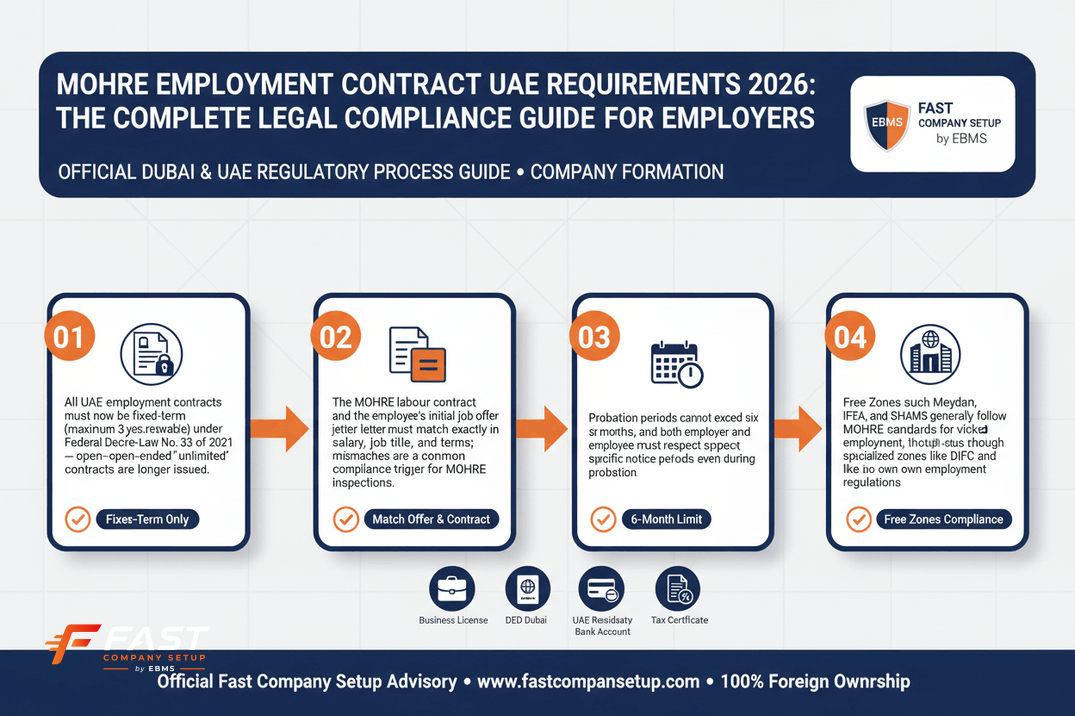
Process roadmap and essential regulatory steps for MOHRE Employment Contract UAE Requirements 2026: The Complete Legal Compliance Guide for Employers.
Mandatory Clauses Every MOHRE Contract Must Include
A compliant MOHRE employment contract is not simply a formality — it is a structured legal document with specific fields that MOHRE's system requires before the contract can be validated and linked to a work permit. Employers who attempt to issue a generic or incomplete contract template risk rejection during the registration process, delays in visa issuance, or disputes later if the contract terms are ambiguous.
The contract must clearly identify the employer and employee, the exact job title and classification as registered with MOHRE, the place of work, the contract start date, and its fixed duration. Remuneration must be broken down into basic salary and any allowances (housing, transport, other benefits), since this breakdown directly affects end-of-service gratuity calculations and Wage Protection System (WPS) salary transfers. Working hours, weekly rest days, and annual leave entitlement must also be stated in line with statutory minimums.
One of the most common compliance issues MOHRE inspectors flag is a mismatch between the employment offer letter issued before entry permit processing and the final labour contract signed inside the UAE. If the salary, job title, or contract type stated in the offer letter differs from what appears in the MOHRE contract, the employee has legal grounds to raise a labour complaint, and the employer may face a compliance flag on their establishment card. For this reason, Fast Company Setup always recommends finalizing exact contract terms before the initial offer letter stage, rather than treating it as a placeholder document.
A mismatch between the offer letter and the final MOHRE labour contract is one of the most frequent triggers for employee complaints and MOHRE inspections. Always align both documents before the employee signs.
Contract Categories and Which One Applies to Your Workforce
Beyond the standard full-time fixed-term contract, MOHRE's 2026 framework also accommodates part-time, temporary, and flexible work arrangements, which have become increasingly relevant as foreign-owned SMEs, startups, and project-based businesses scale their teams without committing to full-time headcount from day one. Choosing the right contract category at the outset avoids the need for restructuring later, which can trigger additional MOHRE fees and amendment procedures.
A part-time contract allows an employee to work for one or more employers simultaneously under reduced hours, provided each employer separately registers the arrangement with MOHRE. A temporary contract is tied to a specific project or defined task with a clear end date, commonly used in construction, events, or short-term consulting engagements. A flexible work contract, meanwhile, is designed for employees whose working hours or workplace vary, such as remote or hybrid roles, and must still specify a minimum structure around hours and compensation.
Employers should also note that contract category selection affects visa sponsorship eligibility, WPS salary transfer obligations, and how statutory leave and gratuity are calculated on a pro-rata basis. Businesses setting up through Dubai Mainland, Meydan Free Zone, or IFZA should discuss their anticipated hiring mix with their formation advisor at the licensing stage, since visa quotas and office space requirements are tied to the number and type of employment contracts a company intends to issue.
If you anticipate a mix of full-time and project-based staff, flag this during company formation. Fast Company Setup's [Cost Calculator](/cost-calculator) can help estimate visa quota and office tier requirements before you commit to a Free Zone package.
| Contract Category | Typical Duration | Notice Period | Best Suited For |
|---|---|---|---|
| Full-Time Fixed-Term | Up to 3 years (renewable) | Minimum 30 days, extendable to 90 by agreement | Core employees on payroll with WPS salary transfers |
| Part-Time | Fixed-term, aligned to primary contract | As agreed, min. statutory notice applies | Employees working reduced hours for one or more employers |
| Temporary / Project-Based | Tied to project completion date | Typically ends with project unless terminated early | Construction, events, short-term consulting |
| Flexible / Remote | Fixed-term with variable hours clause | As agreed, min. statutory notice applies | Hybrid, remote, or variable-schedule roles |
The MOHRE Registration and Digital Onboarding Process
Once a company has an active trade license and establishment card, the employment contract process generally follows a sequence that begins before the employee even enters the UAE. The employer first secures an entry permit (sometimes referred to as an employment visa pre-approval) through MOHRE and the General Directorate of Residency and Foreigners Affairs (GDRFA), based on the agreed job offer terms. This pre-approval stage is where the salary and job title entered into the system must match what will later appear on the signed labour contract.
After the employee enters the UAE (or if they are already a resident switching employer), the employer issues the formal MOHRE labour contract through the ministry's digital platform. Both parties — employer and employee — must review and digitally approve the contract terms via MOHRE's smart application or online portal before it is considered valid. Only after this digital approval is complete can the employer proceed to apply for the employee's work permit, labour card, and subsequent Emirates ID and residence visa stamping.
A properly registered MOHRE contract is also the foundation for Wage Protection System (WPS) compliance, since salary transfers reported through WPS are cross-checked against the basic salary and allowance figures stated in the contract. Discrepancies between WPS salary transfers and the registered contract amount are a recognized red flag that can result in MOHRE compliance restrictions on an establishment's ability to issue new work permits. Employers managing payroll internally should coordinate closely with their Accounting provider to ensure salary disbursements align precisely with registered contract terms every pay cycle.
Manually tracking entry permits, contract approvals, and visa stamping across multiple new hires can create bottlenecks. Fast Company Setup's PRO services coordinate each step so your team's residency and labour documentation move in sequence without delay.
Termination, Gratuity, and Compliance Risks Employers Must Manage
Lawful termination under the 2026 MOHRE framework depends heavily on honoring the notice period stated in the contract, which is a minimum of 30 days and can be extended up to 90 days by mutual written agreement. During probation, which cannot exceed six months, shorter notice periods apply, but employers should confirm the specific day count that applies to their situation with their HR or legal advisor, since probation termination rules differ depending on whether the employee is leaving the UAE or joining another employer locally.
End-of-service gratuity remains calculated on the basis of the employee's basic salary (excluding allowances) and length of service: generally 21 days' basic wage for each of the first five years of service, and 30 days' basic wage for each additional year beyond that, subject to an overall statutory cap. Because gratuity disputes are among the most common labour cases filed with MOHRE, employers should ensure gratuity calculations are documented clearly at the point of termination and reflect the exact basic salary figure stated in the registered contract — not a verbally agreed or informally adjusted figure.
Non-compliance carries real financial and operational risk. Employers who fail to register contracts correctly, who terminate employees without honoring notice periods, or whose WPS transfers do not match contract terms can face restrictions on their ability to issue new work permits, fines, and in repeated cases, downgrading of their MOHRE compliance classification, which affects future visa quota approvals. Companies going through restructuring, downsizing, or full closure should also review how outstanding employment contracts and gratuity liabilities are settled as part of their exit process, since unresolved labour obligations can delay final license cancellation and bank account closure.
Gratuity formulas and notice period rules can be subject to periodic Cabinet updates. Always verify the current calculation method with MOHRE or a qualified labour advisor before finalizing any termination settlement.
Frequently Asked Questions
Questions About This Topic

Abdul Salam
Licensed UAE Corporate AdvisorCompany Formation DeskCEO
Specialist in UAE commercial law, DET mainland trade licenses, and 100% foreign ownership corporate restructuring.