
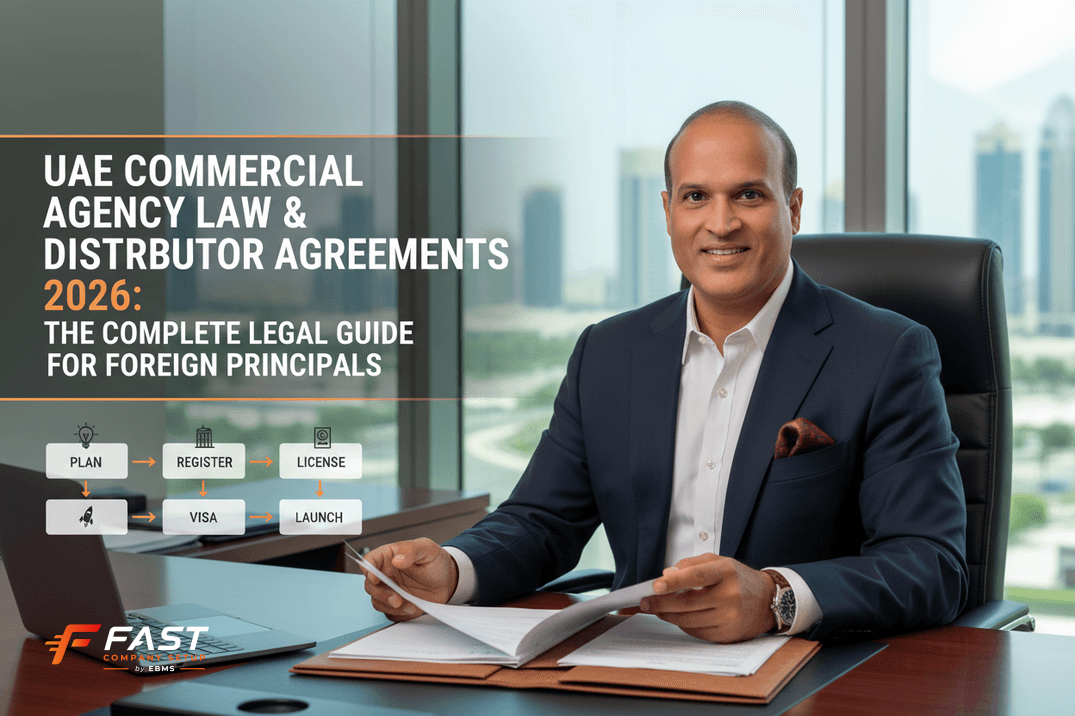
- Federal Law No. 3 of 2022 made commercial agency registration optional, but registered agencies still carry strong statutory protections for the local agent, including compensation exposure for the foreign principal.
- Only UAE nationals or companies wholly owned by UAE nationals can act as a Registered Commercial Agent under the Ministry of Economy register — foreign investors cannot register themselves in this specific capacity.
- Many foreign principals now bypass registered agency risk entirely by forming their own 100% foreign-owned Mainland or Free Zone trading entity and distributing directly or through unregistered distribution contracts.
- Unregistered distribution and reseller agreements offer far more contractual flexibility on termination, exclusivity, and dispute resolution than a formally registered commercial agency.
What UAE Commercial Agency Law Actually Covers in 2026
Foreign manufacturers, brand owners, and exporters entering the UAE market often assume that any local partner who sells their products is automatically a "commercial agent" under UAE law. That assumption is outdated and, in 2026, legally inaccurate in most cases. The UAE's commercial agency regime is governed by Federal Law No. 3 of 2022 Regulating Commercial Agencies, which replaced the older Federal Law No. 18 of 1981. The 2022 law fundamentally changed the relationship between foreign principals and their UAE partners by making registration with the Ministry of Economy's Commercial Agencies Register optional rather than mandatory for most sectors.
This distinction matters enormously. A 'Registered Commercial Agency' is a specific legal status granted only when the agency contract is formally entered into the Ministry of Economy register. Once registered, the agent — who must be a UAE national or a company wholly owned by UAE nationals — gains statutory protections that can make it difficult and costly for a foreign principal to terminate the relationship, change distributors, or exit the UAE market without compensation claims. An unregistered distributor or reseller, by contrast, operates purely under the commercial contract the parties sign, governed by general UAE Civil and Commercial Transactions Law principles, with far more contractual freedom for both sides.
For 2026, the practical question every foreign principal should ask before appointing a UAE partner is not 'do we need a local agent,' but rather: 'should this relationship be a registered commercial agency, an unregistered distribution agreement, or should we instead establish our own licensed UAE entity and distribute directly?' Each path carries different legal exposure, cost structure, and exit flexibility.
Before signing any UAE distribution, reseller, or agency contract, have it reviewed to confirm whether it qualifies — or could later be argued to qualify — as a registered-style commercial agency. Because sector-specific Cabinet decisions evolve, we recommend confirming current classification requirements with Fast Company Setup LLC FZ or a licensed UAE legal advisor before signature.
Registered Commercial Agency vs. Unregistered Distribution Agreement
The single most important distinction in UAE commercial agency law is between a Registered Commercial Agency and an ordinary, unregistered distribution or reseller agreement. Many foreign companies sign a document labelled 'exclusive distribution agreement' without realizing that, if it is actually entered into the Ministry of Economy's register, it transforms into a Registered Commercial Agency with a materially different risk profile.
A Registered Commercial Agency under Federal Law No. 3 of 2022 generally runs for a defined term (commonly structured around multi-year periods, renewable by mutual agreement), and the registered agent benefits from protections around non-renewal, termination for cause, and in some cases compensation for goodwill, inventory, and investment made in building the market — particularly where the foreign principal terminates without what the agent considers a legitimate commercial reason, or chooses not to renew after a long-standing relationship. Disputes historically went through the Ministry of Economy's Commercial Agencies Committee before court escalation; under the 2022 law framework, dispute pathways have shifted toward ordinary courts and arbitration, but the underlying protective intent for the local agent remains.
An unregistered distributorship, by contrast, is a creature of contract. The foreign principal and the UAE distributor negotiate termination notice periods, exclusivity scope, minimum purchase commitments, renewal conditions, and governing law/arbitration seat freely — and these terms are generally enforced as written, without the additional statutory compensation layer that attaches to registered agencies. This gives foreign principals significantly more control over the lifecycle of the relationship, including the ability to switch distributors, introduce parallel channels, or restructure territory coverage as the business scales.
Structuring Your UAE Distribution Entity: Direct Setup vs. Local Partner
Given the exposure attached to registered commercial agencies, an increasing number of foreign manufacturers and brand owners in 2026 choose a third path: forming their own UAE-licensed trading entity rather than appointing a third-party distributor at all. Since the UAE Commercial Companies Law now permits up to 100% foreign ownership for most commercial and trading activities, a foreign principal can establish a Mainland trading company (/dubai-mainland) licensed through Dubai's Department of Economy and Tourism, or an equivalent structure under Abu Dhabi Mainland (/abu-dhabi-mainland) or Sharjah Mainland (/sharjah-mainland), and import, warehouse, and sell its own products directly to UAE retailers and end customers without triggering any agency relationship at all.
This approach eliminates the registered-agency compensation risk entirely because there is no separate local agent to protect — the foreign principal's own UAE entity is the seller of record. It also allows direct control over pricing, branding, retail placement, and after-sales service standards, which many international brands consider essential in competitive UAE retail and B2B markets. The trade-off is operational: the foreign principal must build local market knowledge, retail relationships, logistics, and warehousing from scratch, rather than leveraging an established local distributor's existing network.
A hybrid model is also common: the foreign principal sets up its own UAE Free Zone entity — commonly a Meydan Free Zone (/meydan-freezone) or IFZA Dubai (/ifza-freezone) company for lighter-touch trading, or a Mainland company where local market access and government procurement eligibility matter — and uses that entity to appoint sub-distributors or resellers under short-term, clearly unregistered contracts. This gives the brand a formal UAE footprint for invoicing, banking, and tax residency purposes, while still using local resellers for last-mile market penetration, all without the statutory baggage of a registered commercial agency.
For media, marketing, or content-driven distribution businesses, Shams (Sharjah Media City) (/shams-freezone) is frequently used as a lower-cost entry point when the activity leans toward digital distribution, licensing, or brand representation rather than physical warehousing and import.
Foreign principals who later want to change distributors, renegotiate margins, or exit the UAE market find it far easier to do so when they control their own licensed entity rather than relying on a third-party registered agent whose rights are protected by statute.
Termination, Exclusivity & Compensation Risk Checklist
Whichever structure you choose, the contract itself is where most disputes originate. UAE courts and arbitration panels look closely at how the parties described and conducted the relationship in practice, not just the label on the cover page. A distribution agreement that functions exactly like an exclusive, long-term, territory-wide representation — even if never formally registered — can still be argued by a departing partner to carry agency-like characteristics, especially if the local partner invested heavily in marketing, staffing, or infrastructure on the principal's behalf.
To reduce this risk, foreign principals should ensure every UAE distribution contract explicitly addresses term length and renewal mechanics, termination notice periods and permissible grounds, exclusivity scope (by product line, channel, or emirate rather than blanket nationwide exclusivity), minimum performance or purchase targets tied to renewal, intellectual property and trademark usage limits, and a clear governing law and dispute resolution clause — ideally UAE-seated arbitration (such as DIAC or an onshore/free zone arbitration center) for faster, more predictable outcomes than open-ended litigation.
Compensation risk is the area that catches most foreign companies off guard. Even outside a formally registered agency, a UAE court may award a departing distributor damages for lost profits or unamortized investment if the termination is deemed abrupt, in bad faith, or inconsistent with how the relationship was actually run for years. Clear, well-documented notice periods and performance reviews throughout the relationship — not just at termination — are the strongest protection available to a foreign principal.
Tax, VAT & Banking Considerations for UAE Distribution Structures
Regardless of the structure chosen, every UAE legal entity involved in distribution — whether it is the principal's own Mainland company, a Free Zone trading entity, or an independent local distributor — must register with the Federal Tax Authority for UAE Corporate Tax (/corporate-tax-filing-dubai) and obtain a Corporate Tax TRN. Under Federal Decree-Law No. 47 of 2022 and subsequent 2026 Cabinet Decisions, the standard 9% rate applies to taxable net profits exceeding AED 375,000, with 0% on profits up to that threshold. Resident entities with gross revenue at or below AED 3,000,000 in the relevant tax period may elect for Small Business Relief, which treats them as having no taxable income for that period, subject to the conditions published by the FTA.
Free Zone distribution entities that qualify as Qualifying Free Zone Persons may benefit from 0% Corporate Tax on qualifying income — generally transactions with other Free Zone persons or qualifying export activity — while non-qualifying, Mainland-sourced distribution revenue is taxed at the standard 9% rate. This is a critical structuring point: a Free Zone trading company that sells heavily into the UAE local Mainland retail market may find a meaningful share of its revenue falls outside the 0% regime, which should be modeled carefully before choosing jurisdiction.
On VAT, any distribution entity exceeding AED 375,000 in annual taxable turnover must register for the standard 5% VAT and file returns; voluntary registration is available from AED 187,500 in turnover or expenses, which can benefit early-stage distributors looking to recover input VAT on import duties and logistics costs. Finally, because distribution businesses typically carry inventory, import documentation, and supplier contracts, banks reviewing corporate account applications — including Emirates NBD, Mashreq, RAKBANK, FAB, CBD, and digital-first Wio Bank — will expect clear trade flow documentation. Proper accounting and bookkeeping (/accounting-services-in-dubai) from day one, including IFRS-compliant records retained for at least five years as required under UAE Commercial Law, materially speeds up both bank account activation and any future audit or compensation dispute defense.
Government fees, licensing costs, and tax thresholds are subject to change under UAE Cabinet Decisions. Always confirm current figures with Fast Company Setup LLC FZ or the relevant authority before budgeting your distribution structure.
| Distribution Structure | Who Controls Termination Rights | Typical Setup Cost Range (AED) | Best Suited For |
|---|---|---|---|
| Registered Commercial Agency (UAE national-owned) | Shared — strong statutory protection for local agent | No formation cost; registration/legal fees only | Regulated sectors needing an established UAE national partner network |
| Unregistered Distribution/Reseller Agreement | Mostly the foreign principal, per contract terms | No formation cost; legal drafting fees only | Brands wanting flexible exit and renegotiation rights |
| Own Mainland Trading Company | Fully controlled by the foreign principal | AED 15,000 – 35,000+ (activity-dependent) | Direct local retail, government tenders, long-term UAE market presence |
| Own Free Zone Trading Entity (e.g., Meydan, IFZA) | Fully controlled by the foreign principal | AED 8,000 – 20,000+ (package-dependent) | Re-export, e-commerce, regional distribution with lighter UAE retail footprint |
Frequently Asked Questions
Questions About This Topic

Abdul Salam
Licensed UAE Corporate AdvisorCompany Formation DeskCEO
Specialist in UAE commercial law, DET mainland trade licenses, and 100% foreign ownership corporate restructuring.