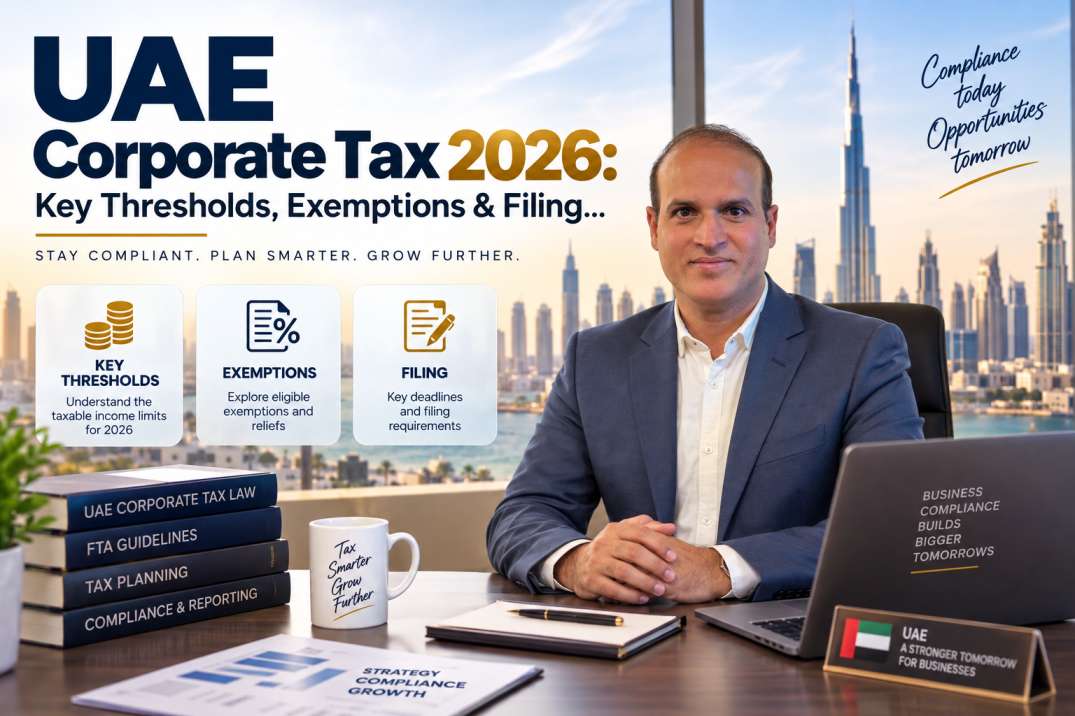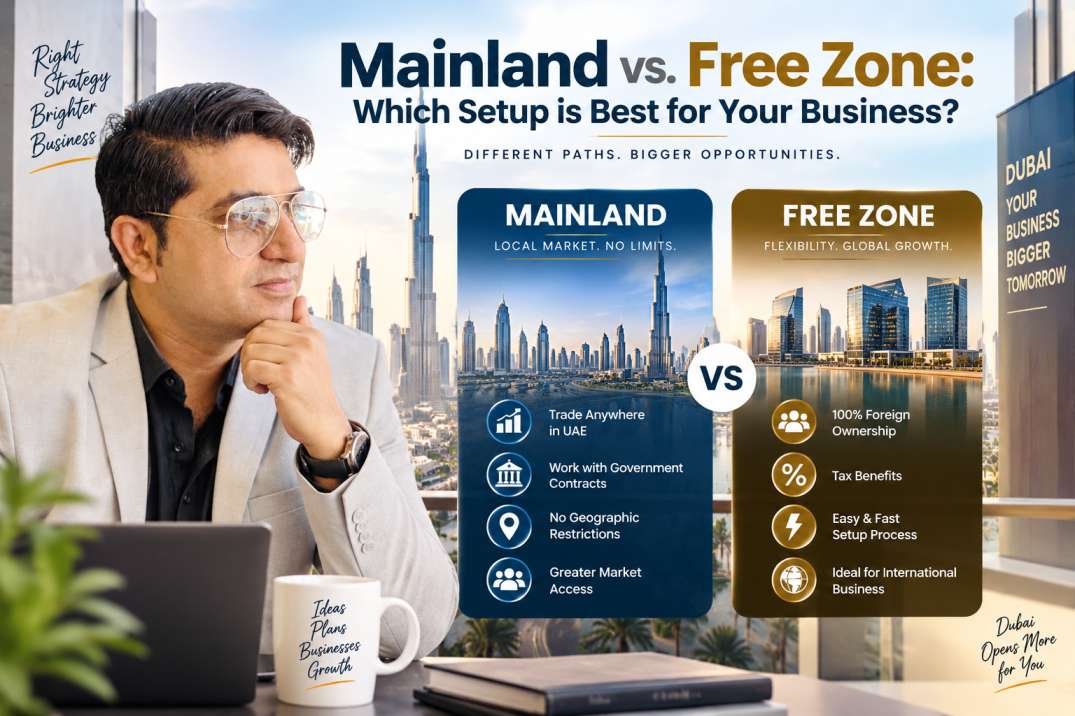


- A Free Zone entity does not automatically get 0% Corporate Tax — it must qualify as a Qualifying Free Zone Person (QFZP) under Cabinet Decision No. 100 of 2023 and meet strict activity-based tests every tax period.
- Only income from specific 'Qualifying Activities' — such as manufacturing, distribution within Designated Zones, fund management, and headquarter services to related parties — can benefit from the 0% rate.
- A single de minimis breach (non-qualifying revenue exceeding the lower of 5% of total revenue or AED 5,000,000) can disqualify an entire entity from QFZP status for that tax period and the following four periods.
- Mainland-sourced commercial revenue earned by a Free Zone company is automatically taxed at the standard 9% rate, regardless of how the rest of the business is structured.
Why the 0% Free Zone Rate Is Conditional, Not Automatic
Many foreign investors still believe that registering a company in a UAE free zone automatically guarantees a 0% Corporate Tax rate forever. That assumption was accurate before the Federal Decree-Law No. 47 of 2022 came into full effect, but it is no longer the case in 2026. The UAE's Corporate Tax regime created a distinct legal category called the Qualifying Free Zone Person (QFZP), and only entities that satisfy a defined set of conditions each tax period are entitled to apply the 0% rate on their Qualifying Income. Everyone else — even if their license is issued by a free zone authority — pays the standard 9% rate on taxable profits above AED 375,000, exactly like a mainland company.
This distinction matters enormously for how a business structures its contracts, invoicing, and client relationships. A free zone trading company that sells to UAE mainland retail customers, a consultancy that works directly with mainland corporates, or a logistics firm that mixes qualifying and non-qualifying revenue streams without proper segregation can inadvertently lose its 0% status for the entire tax period — and in some cases for several subsequent periods as well.
The Federal Tax Authority (FTA) and the Ministry of Finance have issued detailed guidance — most notably Cabinet Decision No. 100 of 2023 and Ministerial Decision No. 265 of 2023 — that lists exactly which business activities count as 'Qualifying Activities,' which are explicitly 'Excluded Activities,' and how much non-qualifying revenue a company is permitted before it fails the test entirely. Understanding this framework is now a core part of free zone tax planning, not an afterthought handled during annual filing.
Before signing new client contracts, map every revenue stream against the Qualifying Activities list. A quick classification review can prevent an entire year's profit from being taxed at 9% due to one misclassified transaction.
The Qualifying Activities List: What Actually Earns the 0% Rate
Ministerial Decision No. 265 of 2023 sets out a specific, closed list of activities that generate Qualifying Income. If your free zone company's revenue does not fall within one of these categories — and is not earned from a transaction with another free zone person who is itself the beneficial recipient — it generally will not benefit from the 0% rate, even if the invoice is raised from inside a free zone.
It's important to separate two different qualifying pathways: income earned from transactions with other free zone persons (provided that other entity is the beneficial recipient of the goods or services, not simply a pass-through), and income earned from specific listed activities regardless of who the counterparty is, including qualifying exports outside the UAE. Both pathways require careful contract structuring and invoice-level recordkeeping.
Distribution activity only qualifies when goods move through a formally recognized Designated Zone (such as JAFZA or certain DAFZA/KIZAD areas). Operating from a non-Designated Zone free zone for a trading license does not automatically unlock the distribution exemption — confirm your specific free zone's Designated Zone status before relying on this category.
Excluded Activities and the De Minimis Rule: Where 0% Status Breaks Down
Just as important as the qualifying list is the Excluded Activities list, because these revenue streams are specifically carved out from the 0% benefit even if conducted from within a free zone. Income from Excluded Activities is always taxed at 9%, and critically, it also counts toward the de minimis threshold that can jeopardize your entire QFZP status.
The de minimis rule, found in Cabinet Decision No. 100 of 2023, states that non-qualifying revenue must not exceed the lower of 5% of total revenue or AED 5,000,000 in a given tax period. If a free zone company breaches this threshold — even inadvertently through one large mainland sale or an unclassified consultancy invoice — it loses QFZP status for that entire tax period, and under the current framework, for the following four tax periods as well. This is one of the most consequential and least understood penalties in the entire regime, because it is not a fine; it is a complete reclassification of the business's tax profile for up to five years.
Common Excluded Activities include transactions with natural persons (with narrow exceptions for ship, aircraft, and intellectual property transactions), banking activities subject to regulatory oversight, insurance activities (other than qualifying reinsurance), finance and leasing activities subject to regulatory oversight (other than the qualifying treasury and aircraft leasing categories listed earlier), and the ownership or exploitation of intellectual property assets. Income from the ownership or exploitation of immovable property is also excluded unless it is commercial property located in a free zone and the transaction is with another free zone person.
A single breach of the 5% / AED 5,000,000 de minimis threshold can push your entire entity into standard 9% taxation for the current period plus the following four periods. This is why revenue stream segregation and monthly bookkeeping accuracy matter far more under Corporate Tax than they did before 2023.
Substance, Transfer Pricing, and Audit Documentation Requirements
Qualifying for the 0% rate is not purely about activity classification — the FTA also requires evidence of adequate economic substance within the UAE. A Qualifying Free Zone Person must maintain adequate assets, incur adequate operating expenditure, and employ an adequate number of qualified full-time employees relative to the activity being conducted. A free zone company with a qualifying activity on paper but no genuine operational footprint in the UAE is unlikely to withstand FTA scrutiny during an audit.
Transfer pricing documentation becomes especially important for free zone entities earning Qualifying Income from Related Party transactions — for example, headquarter services or treasury and financing services provided to a related mainland or international entity. These transactions must be priced on an arm's length basis, properly documented, and supported by a Local File and, where thresholds are met, a Master File under the UAE's transfer pricing rules aligned with OECD guidance.
Audited financial statements are mandatory for all entities seeking to claim QFZP status, in addition to the general requirement under UAE Commercial Law to maintain IFRS-compliant books of accounts for at least five years. The FTA has made clear that a free zone entity cannot simply self-declare 0% treatment on its Corporate Tax return — the figures must trace back to properly segregated, audited revenue classifications. This is precisely where many businesses — particularly those managing their own bookkeeping without specialized UAE tax expertise — run into trouble, because generic accounting software does not automatically separate qualifying from non-qualifying revenue streams.
Our certified FTA Tax Agents at the Fast Company Setup Tax Advisory Desk review your invoicing structure and revenue mix before filing season, flagging any transactions that risk breaching the de minimis threshold. Learn more about our dedicated corporate tax filing support at /corporate-tax-filing-dubai, and keep your books QFZP-ready through our /accounting-services-in-dubai team.
Structuring Your Free Zone Entity Correctly: Mainland Exposure, Jurisdiction Choice, and Practical Scenarios
The jurisdiction you choose for your free zone license can influence how straightforward it is to maintain QFZP status, particularly if your business plans to sell both within free zones and into the UAE mainland market. Free zones with Designated Zone status, such as JAFZA, offer a cleaner path for distribution activities, while general-purpose free zones such as Meydan Free Zone and IFZA Dubai are well suited to consultancy, e-commerce, and holding company structures where qualifying income is derived primarily from other free zone persons or foreign clients outside the UAE.
A frequent structuring question we receive involves businesses that need both free zone and mainland access — for example, a media or marketing company registered through SHAMS that also wants to invoice UAE mainland clients directly. In these cases, many investors choose a dual-entity approach: keeping the free zone entity focused on qualifying export or inter-free-zone revenue, while routing mainland commercial activity through a separate mainland company registered under DET or DED rules. This avoids blending non-qualifying mainland revenue into the free zone entity's books and protects its QFZP status.
The table below outlines how different free zone structuring approaches typically compare when it comes to preserving 0% Corporate Tax eligibility. These are general structural patterns — your specific eligibility always depends on your actual activity classification, contract terms, and revenue mix, which should be reviewed individually.
If your free zone entity regularly serves UAE mainland clients, review whether a complementary /dubai-mainland company better protects your free zone QFZP status while still allowing unrestricted local trade.
| Structuring Approach | Typical Setup Cost Range (AED) | QFZP Fit | Best Suited For |
|---|---|---|---|
| Single Free Zone Entity (Export/B2B Focus) | AED 12,000 – 20,000 | Strong — easier to isolate qualifying income | Consultancies, holding companies, fund management |
| Free Zone Entity in a Designated Zone | AED 15,000 – 25,000 | Strong for distribution activities | Import/export, warehousing, logistics |
| Free Zone + Separate Mainland Entity (Dual Structure) | AED 25,000 – 45,000 combined | Protects QFZP by isolating mainland revenue | Businesses serving both local UAE and international clients |
| Single Free Zone Entity Selling Directly to Mainland | AED 12,000 – 20,000 | High risk — de minimis breach likely | Not recommended without active revenue monitoring |
Frequently Asked Questions
Questions About This Topic

Abdul Salam
Licensed UAE Corporate AdvisorTax & Accounting DeskCEO
Certified Tax Agent specializing in UAE 9% Corporate Tax registration, Small Business Relief (SBR), transfer pricing, and VAT compliance.