

- A private clinic in Dubai needs two separate approvals: a DET commercial/professional license and a DHA facility license issued through the Sheryan platform.
- DHA classifies clinics by scope (General Practice, Specialized, Polyclinic, Day Care Surgery, Dental, Physiotherapy) and each category carries distinct space, staffing, and equipment requirements.
- Every physician, dentist, and allied health professional must hold a valid DHA professional license, which requires Prometric/DataFlow verification before practicing.
- 100% foreign ownership is generally available for medical professional licenses on the Dubai Mainland, but facility fit-out, technical file submission, and inspection timelines require realistic planning of 3 to 6 months.
Understanding the DHA Regulatory Framework for Private Healthcare Facilities
The Dubai Health Authority (DHA) is the sole regulator for private healthcare facilities operating within the Emirate of Dubai, excluding free zones such as Dubai Healthcare City, which maintains its own regulatory authority. Any entrepreneur, physician group, or international healthcare operator planning to open a clinic, polyclinic, day care surgery center, dental practice, or allied health facility in Dubai must secure a facility license from DHA in addition to the underlying commercial or professional trade license issued by the Dubai Department of Economy and Tourism (DET).
This dual-track structure often surprises first-time healthcare investors. The DET license establishes the legal commercial existence of the company and is a prerequisite for DHA's facility review process, but it does not itself authorize clinical operations. DHA evaluates the proposed facility against clinical, technical, infrastructure, and staffing standards before issuing the facility license that actually permits patient treatment. Both approvals must remain valid and be renewed annually, and DHA inspections can occur both pre-licensing and periodically during operation.
Because medical licensing touches public health and patient safety, DHA applies a materially higher documentation and inspection standard than most commercial activities. Investors should expect technical file submissions, architectural drawing reviews, equipment specification checks, infection control audits, and verification of every practicing clinician's credentials before a license is issued.
Confirm your clinic's physical jurisdiction before signing any lease. A location inside Dubai Healthcare City follows a different licensing authority entirely, while a standard commercial building anywhere else in Dubai falls under DHA and requires DET mainland registration under /dubai-mainland.
Infographic: Healthcare Clinic License Dubai DHA 2026: The Complete Regulatory Roadmap for Foreign Medical Investors
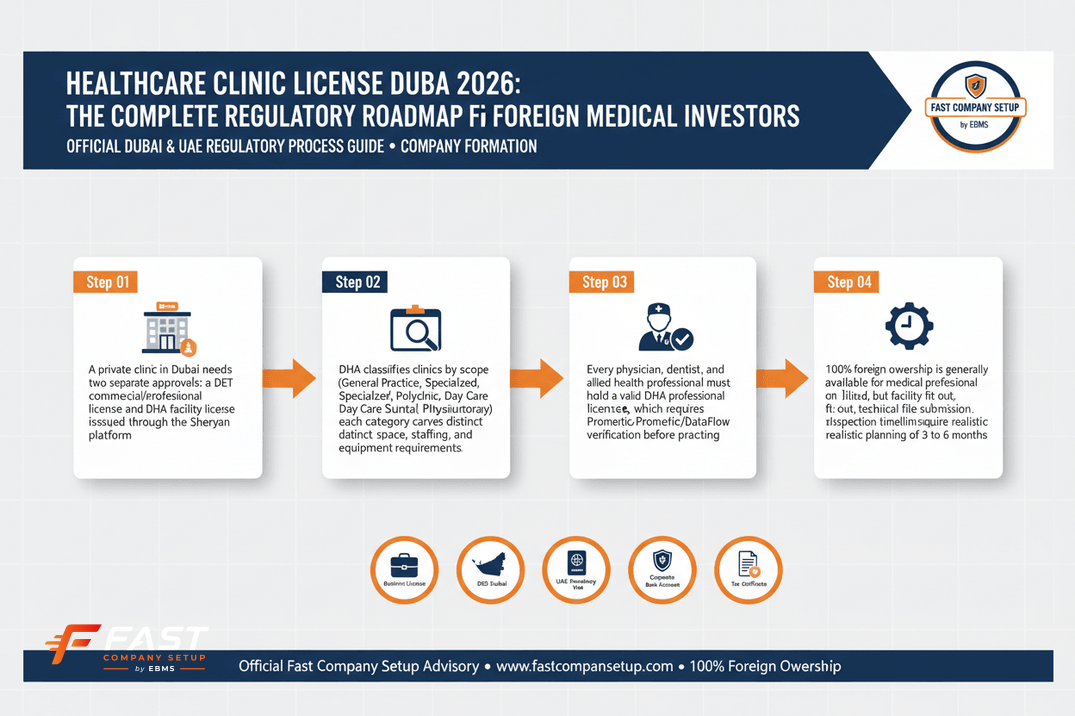
Process roadmap and essential regulatory steps for Healthcare Clinic License Dubai DHA 2026: The Complete Regulatory Roadmap for Foreign Medical Investors.
Clinic Classification and License Categories Under DHA
DHA does not issue a single generic 'clinic license.' Instead, facilities are classified according to clinical scope, risk level, and the procedures performed on site. Choosing the correct classification at the outset is critical because it determines minimum built-up area, required medical equipment, staffing ratios, and the complexity of the technical file DHA will review.
A General Practice Clinic, for example, is intended for primary care consultations and does not typically require operating theatre infrastructure, whereas a Specialized Clinic (such as dermatology, cardiology, or orthopedics) must demonstrate equipment and staff competencies specific to that specialty. Facilities offering minor procedures under local or regional anesthesia, such as a Day Care Surgery Center, face considerably stricter infrastructure, recovery room, and emergency protocol requirements. Dental clinics and physiotherapy centers each have their own dedicated classification pathways with tailored checklists.
A Polyclinic, which houses multiple specialties and practitioners under one facility license, is popular with investors seeking to build a multi-disciplinary practice from day one, but it also demands a larger built-up area and a broader compliance file covering each specialty offered.
The Step-by-Step DHA and DET Licensing Pathway for 2026
Opening a DHA-regulated clinic follows a sequential process that blends corporate registration with clinical facility approval. Skipping steps or submitting incomplete technical files is the most common cause of delay, so investors are strongly advised to prepare documentation in parallel rather than sequentially wherever DHA and DET requirements overlap.
The process generally begins with activity selection and initial approval from DET for a medical professional or commercial license on the /dubai-mainland jurisdiction, since DHA facilities are not typically issued under free zone structures. Once the DET initial approval and trade name reservation are secured, the applicant submits a facility license application through DHA's Sheryan portal, including the proposed location, floor plans, equipment schedule, and a list of all clinicians intended to practice at the facility.
DHA then reviews the technical file and, depending on the facility classification, may request architectural drawing amendments, additional infection control measures, or revised staffing plans before granting an initial 'No Objection' or conditional approval. Following lease finalization and fit-out according to DHA-approved drawings, a physical inspection is scheduled. Only after a satisfactory inspection does DHA issue the final facility license, which is then paired with the DET commercial license to allow the clinic to commence operations.
In parallel, every physician, dentist, nurse, and allied health professional intended to work at the clinic must independently hold or obtain a DHA professional license. This requires primary source verification of qualifications through DataFlow Group, and in most cases a Prometric licensing examination relevant to the clinician's specialty, before DHA issues the individual practicing license linked to the facility.
Many investors sign a commercial lease before DHA has reviewed the floor plan, then discover the space does not meet minimum area or layout requirements for their chosen classification. Always obtain DHA preliminary feedback on floor plans before committing to a lease.
Facility, Staffing, and Technical Requirements Investors Must Plan For
Beyond the licensing sequence itself, DHA imposes substantive operational standards that shape how a clinic must be designed, staffed, and run. These requirements are not negotiable formalities; they reflect patient safety obligations that DHA inspectors actively verify both before opening and during periodic compliance visits.
Every DHA-licensed facility must appoint a Medical Director who is personally accountable for clinical governance, and larger facilities such as polyclinics or day care surgery centers typically require additional designated roles such as an Infection Control Officer and a Radiation Safety Officer where imaging equipment is used. Staffing ratios between physicians, nurses, and support staff are assessed against the facility's declared patient capacity and clinical scope.
Technical infrastructure requirements cover areas such as medical waste disposal contracts with DHA-approved vendors, fire and life safety certification coordinated with Dubai Civil Defence, minimum consultation and procedure room dimensions, and equipment calibration and maintenance records. Facilities using radiology, laser, or other regulated equipment must separately register that equipment with DHA and, in some cases, with the UAE's radiation protection authority.
Finally, ongoing compliance does not end at licensing. DHA requires annual facility license renewal, continuing professional development hours for licensed clinicians, incident reporting for adverse clinical events, and participation in DHA's quality and patient safety programs. Investors should budget for a compliance function, whether in-house or outsourced, from the outset rather than treating licensing as a one-time event.
Ownership Structure, Costs, Taxation, and Visa Planning for Clinic Owners
Foreign investors can generally structure a DHA-regulated clinic with 100% foreign ownership under the mainland framework introduced by the UAE Commercial Companies Law reforms, provided the medical professional activity qualifies and any sector-specific DHA ownership or qualification conditions for the Medical Director and licensed practitioners are satisfied. Because DHA facilities fall outside standard free zone structures, the clinic's trading entity is typically registered on the /dubai-mainland rather than through a free zone such as /meydan-freezone or /ifza-freezone, which are better suited to non-clinical commercial or professional services rather than DHA-regulated medical practice.
Clinics, like all UAE legal entities, must register with the Federal Tax Authority for Corporate Tax regardless of revenue size, and profits exceeding AED 375,000 are generally subject to the standard 9% rate unless Small Business Relief applies for qualifying resident persons with gross revenue at or below AED 3,000,000 in the relevant tax period. Our team supports clinic owners through /corporate-tax-filing-dubai to ensure timely TRN registration and accurate filing, alongside IFRS-aligned /accounting-services-in-dubai to maintain the statutory books of account that DHA and the FTA may both request during audits or inspections.
Clinic founders who meet the qualifying capital or shareholding thresholds may also explore the UAE's 10-Year Golden Visa for business investors, which offers renewable, self-sponsored residency without requiring an employer sponsor. Details on eligibility and the application sequence are outlined on our /golden-visa-uae resource page, and our advisory team can assess whether a clinic's ownership structure and valuation support an investor-category application.
Budgeting for a DHA clinic should account for DET license fees, DHA facility license fees, individual DHA professional licensing fees per clinician, fit-out costs to DHA specifications, equipment procurement, and ongoing compliance costs. Because DHA fee schedules, classification requirements, and inspection checklists are periodically updated, investors should always confirm current figures directly with DHA or through a licensed consultancy before finalizing a business plan.
Use our /cost-calculator to model preliminary DET and setup costs, then schedule a consultation so our team can map DHA facility and staffing costs specific to your chosen clinic classification before you commit to a lease.
| Clinic Classification | Typical Setup Complexity | Indicative Timeline | Key Distinguishing Requirement |
|---|---|---|---|
| General Practice Clinic | Low to Moderate | 3-4 months | Primary care consultation rooms, no theatre infrastructure |
| Specialized Clinic | Moderate | 3-5 months | Specialty-specific equipment and clinician qualifications |
| Dental Clinic | Moderate | 3-4 months | Dedicated sterilization and radiology compliance |
| Physiotherapy Center | Low to Moderate | 3-4 months | Therapy equipment and allied health staffing ratios |
| Polyclinic | High | 4-6 months | Multiple specialties, Medical Director, larger built-up area |
| Day Care Surgery Center | High | 5-6+ months | Recovery bay, anesthesia protocols, emergency readiness |
Frequently Asked Questions
Questions About This Topic

Abdul Salam
Licensed UAE Corporate AdvisorCompany Formation DeskCEO
Specialist in UAE commercial law, DET mainland trade licenses, and 100% foreign ownership corporate restructuring.